久草精品视频在线播放,中文人妻AV久久人妻水密桃,av免费观看精品,亚洲五月激情综合图片区 日本成熟少妇A∨网站,久久看亚洲欧美,久久久久久人妻精品一区,久久亚洲Aⅴ无码影院

產(chǎn)品中心

Rad51 rabbit pAb

一鍵復(fù)制產(chǎn)品信息
ES3307
規(guī)格: 價(jià)格:
50μL ¥1280.00
100μL ¥1980.00

Overview

Product name: Rad51 rabbit pAb
Reactivity: Human;Mouse
Alternative Names: RAD51; RAD51A; RECA; DNA repair protein RAD51 homolog 1; HsRAD51; hRAD51; RAD51 homolog A
Source: Rabbit
Dilutions: Western Blot: 1/500 - 1/2000. Immunohistochemistry: 1/100 - 1/300. ELISA: 1/20000. Not yet tested in other applications.
Immunogen: The antiserum was produced against synthesized peptide derived from human RAD51. AA range:281-330
Storage: -20°C/1 year
Clonality: Polyclonal
Isotype: IgG
Concentration: 1 mg/ml
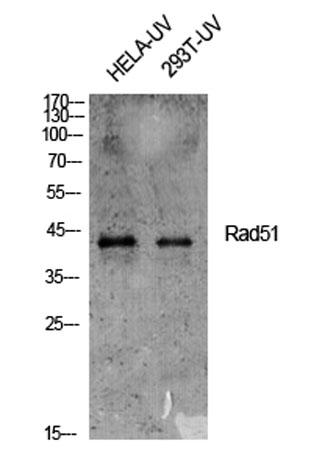
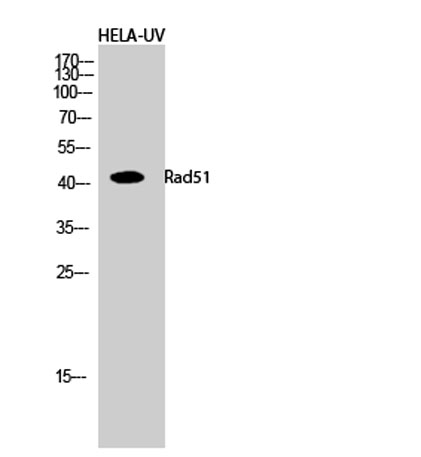
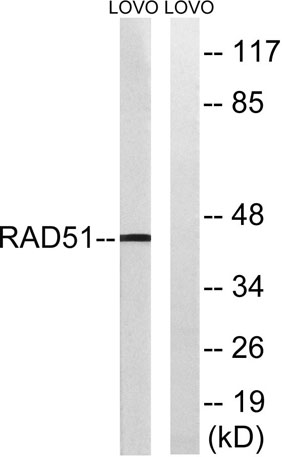
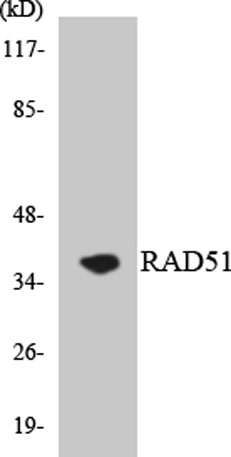
Observed Band: 42kD
GeneID: 5888
Human Swiss-Prot No: Q06609
Cellular localization: Nucleus . Cytoplasm . Cytoplasm, perinuclear region. Mitochondrion matrix . Chromosome . Cytoplasm, cytoskeleton, microtubule organizing center, centrosome . Colocalizes with RAD51AP1 and RPA2 to multiple nuclear foci upon induction of DNA damage (PubMed:20154705). DNA damage induces an increase in nuclear levels (PubMed:20154705). Together with FIGNL1, redistributed in discrete nuclear DNA damage-induced foci after ionizing radiation (IR) or camptothecin (CPT) treatment (PubMed:23754376). Accumulated at sites of DNA damage in a SPIDR-dependent manner (PubMed:23509288). Recruited at sites of DNA damage in a MCM9-MCM8-dependent manner (PubMed:23401855). Colocalizes with ERCC5/XPG to nuclear foci in S phase (PubMed:26833090). .
Background: The protein encoded by this gene is a member of the RAD51 protein family. RAD51 family members are highly similar to bacterial RecA and Saccharomyces cerevisiae Rad51, and are known to be involved in the homologous recombination and repair of DNA. This protein can interact with the ssDNA-binding protein RPA and RAD52, and it is thought to play roles in homologous pairing and strand transfer of DNA. This protein is also found to interact with BRCA1 and BRCA2, which may be important for the cellular response to DNA damage. BRCA2 is shown to regulate both the intracellular localization and DNA-binding ability of this protein. Loss of these controls following BRCA2 inactivation may be a key event leading to genomic instability and tumorigenesis. Multiple transcript variants encoding different isoforms have been found for this gene. [provided by RefSeq, Aug 2009],
關(guān)閉

在線咨詢

Online consultation

  • 在線咨詢
  • 技術(shù)支持

關(guān)注微信公眾號(hào)

微信掃一掃立即咨詢

微信掃一掃立即咨詢

關(guān)閉